Iran Nuclear Talks: Diplomacy or Deception?
The Venue Dispute and Talks Framework
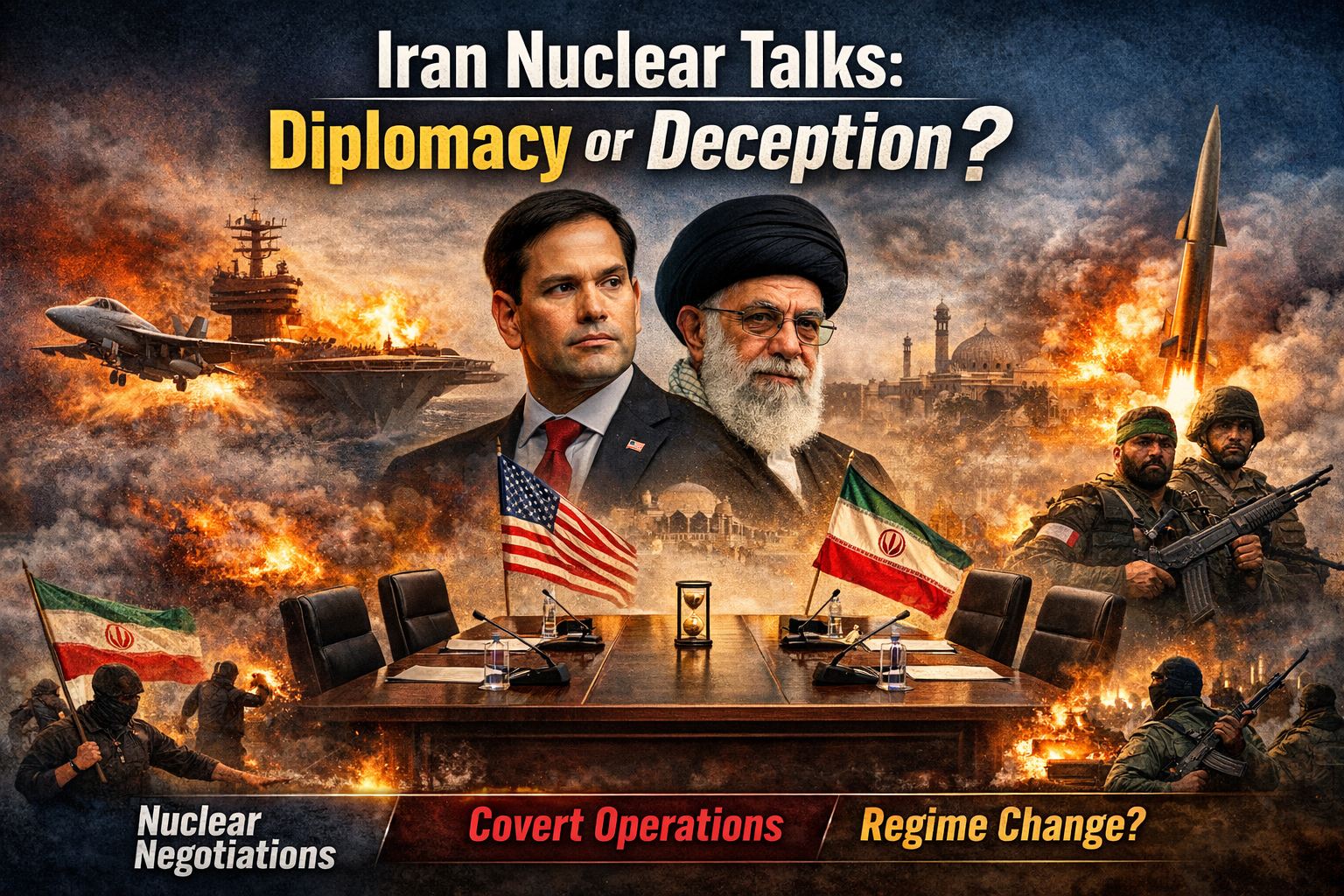
Secretary of State Marco Rubio confirmed that Iran requested to change locations for talks with U.S. counterparts, with negotiations now set for Friday in Muscat, Oman, rather than the originally planned Istanbul venue. Iran requested the move to keep negotiations focused solely on its nuclear program, seeking to prevent the agenda from expanding to other contentious issues.
The U.S. and Iran have fundamentally different agendas for these discussions. Rubio stated the U.S. wants negotiations to cover Iran's nuclear program, ballistic missile range, sponsorship of terrorist organizations, and treatment of Iranian people.
In contrast, Iran has insisted discussions be limited strictly to its nuclear program with the lifting of sanctions as the country's primary demand.
Trump's Warnings and Military Posture
President Trump warned that Iran's supreme leader should be "very worried" as both sides prepare for their first formal negotiations since the U.S. bombed Tehran's nuclear program last year. Trump said his actions have supported demonstrators during Iran's crackdown on protests, despite stopping short of direct intervention.
The administration has deployed significant military assets to the region. Trump sent a U.S. military "armada" to the region and threatened to launch strikes following Iran's violent suppression of anti-government protests.
Recent Military Incidents
Tensions escalated sharply this week with multiple confrontations. A U.S. Navy fighter jet shot down an Iranian drone that approached an American aircraft carrier, and Iranian fast boats from its paramilitary Revolutionary Guard tried to stop a U.S.-flagged ship in the Strait of Hormuz.
The Institute for the Study of War said these incidents fit the pattern of a "probing action" that seeks to test the strength, disposition, and reactions of an opposing force. The think tank suggested Iran was deliberately showcasing its capacity to challenge U.S. naval activity and potentially deter strikes.
Domestic Protests and Violent Crackdown
The backdrop to these negotiations is Iran's brutal response to nationwide anti-government demonstrations that began on December 28, 2025. The protests erupted across multiple cities amid nationwide unrest against the Islamic Republic government and a deepening economic crisis, representing the largest uprising since the 1979 Islamic Revolution.
The scale of state violence has been unprecedented. The ensuing crackdown, carried out under Ali Khamenei's and senior officials' order for live fire on protesters, resulted in massacres that left tens of thousands of protesters dead, making them the largest massacres in modern Iranian history. As of 14 January 2026, over 18,400 people had been arrested.
Rubio emphasized that "the Iranian people and the Iranian regime are very unalike," noting "the leadership of Iran at the clerical level does not reflect the people of Iran."
The Regime Change Question and it’s Impact on Nuclear Talks
Trump's Ambiguous Stance on Regime Change
During the war, US President Donald Trump publicly raised the prospect of regime change—not as declared policy, but as a conceivable outcome should Iran prove unable to govern or stabilize the country.
Trump has swung wildly between diplomacy and belligerence, floating new nuclear talks, imposing new tariffs, then calling on Iranians to "KEEP PROTESTING – TAKE OVER YOUR INSTITUTIONS."
According to Western diplomats and Arab officials, Trump wants to create conditions for "regime change" in Iran rather than directly topple the government. However, there's significant debate about whether this approach helps or hinders the protest movement.
The Succession Crisis and Power Vacuum
With the loss of many of Khamenei's top lieutenants during last summer's war, the cohesiveness of Iran's decision-making apparatus is now being tested as factional rivalries jockey for position, awaiting the moment Khamenei passes from the scene. Analysts note that even if the regime were to fall, there is a range of possible outcomes, including further clerical or military rule and democracy.
Experts agreed on one point: there is no clear successor waiting in the wings. The various Iranian dissident groups supporting the protests lack a shared ideology and method. Potential figures include former Crown Prince Reza Pahlavi, who retains symbolic support and has an administrative plan to restore the monarchy, as well as detained Green Movement leaders and former reformist presidents.
Regional Fears of Instability
Across the region, from the Gulf to Turkey, officials favor containment over collapse—not out of sympathy for Tehran, but out of fear that turmoil inside a nation of 90 million, riven by sectarian and ethnic fault lines, could unleash instability far beyond Iran's borders.
A fractured Iran could spiral into civil war as happened after the 2003 US invasion of Iraq, unleashing an influx of refugees, fueling Islamist militants, and disrupting oil tankers through the Strait of Hormuz, a global energy chokepoint.
Why Regime Change Complicates Negotiations
The possibility of regime change creates several paradoxes for the nuclear talks:
Iran's Negotiating Desperation vs. Defiance: Iran's leadership enters this phase struggling with military setbacks, economic collapse and mass protest that have narrowed its strategic options. Yet nuclear rollback would weaken deterrence; missile constraints would erode Iran's asymmetric posture; proxy disengagement would dismantle its regional influence architecture—making any comprehensive deal potentially suicidal for the regime.
The Foreign Intervention Paradox: A foreign attack could shift ordinary citizens' focus away from protesting, as anti-government protests were gaining momentum last June when the 12-day war broke out, giving Tehran a six-month reprieve from popular discontent. This means U.S. military threats might actually strengthen the regime in the short term.
Legitimacy Crisis for Any Deal: If the Islamic Republic is on the verge of collapse, any agreement it signs may lack legitimacy with whatever government follows. Conversely, if Trump is seen as genuinely pursuing regime change, Iran has no incentive to make concessions that would weaken it further.
The IRGC Wild Card: The Islamic Revolutionary Guard Corps would not necessarily disappear in any post-Khamenei Iran, given the group's extensive military and economic presence. Many analysts fear the IRGC could take over in a power vacuum, entrenching hardline rule and deepening the nuclear standoff.
Clandestine Operations: "Prepping the Battlefield" Through The Third Option
While Trump publicly signals openness to regime change, intelligence reporting suggests a sophisticated covert action campaign is already underway—what intelligence scholars call "The Third Option," the pathway between diplomacy and war.
The Third Option Doctrine
Covert action is codified in Title 50, U.S. Code as an activity of the United States Government to influence political, economic, or military conditions abroad, where it is intended that the role of the US Government be concealed. The Latin motto of the CIA's Special Activities Center is Tertia Optio, which means "Third Option," as covert action represents an additional option within the realm of national security when diplomacy and military action are not feasible.
For Iran specifically, this playbook is well-established. In the early 1950s, the CIA and Britain's Secret Intelligence Service overthrew the democratically elected government of Iran, Prime Minister Mohammed Mosaddeq, in Operation Ajax, utilizing all components, including political action, covert influence, and paramilitary operations.
CIA-Mossad Joint Operations
Recent reporting confirms extensive intelligence cooperation targeting Iran's regime. Mossad chief David Barnea thanked the US Central Intelligence Agency, stating cooperation "helped make the operation possible" during June 2025's Operation Rising Lion. The operation demonstrated close cooperation between Mossad and the CIA, with Israeli spy chief acknowledging "I want to express appreciation and recognition of our main partner, the CIA, for the joint activities."
The scope of penetration is remarkable. Former Iranian President Mahmoud Ahmadinejad revealed that Iran's intelligence service unit designed to counter Mossad operations had its leader exposed as a Mossad double agent in 2021, with about 20 Iranian operatives working as double agents.
Current Operations Supporting Protesters
Former US Secretary of State Mike Pompeo, also a former CIA director, acknowledged the presence of Israeli agents on the ground in Iran, posting on social media: "Happy New Year to every Iranian in the streets. Also, to every Mossad agent walking beside them."
Intelligence analysts believe operations are ongoing. "My assumption is that the Mossad is active in Tehran behind the scenes," said intelligence expert Ahron Bregman, adding "I assume there are Israeli agents on the ground, reporting back on the situation from the streets, particularly now that the internet in Iran is down."
Foreign actors had armed Iranians to help them fight against the regime's forces being used to crack down on protesters, Channel 14 reported. Iranian authorities have arrested individuals they claim were receiving dollar payments from outside the country in exchange for provoking the public, with raids uncovering weapons, ammunition, and bomb-making materials indicating a plot to escalate unrest into armed violence.
Strategic Framework: "Death by a Thousand Cuts"
Former Israeli Prime Minister Naftali Bennett conveyed his views about bringing down Iran's regime through a "death by a thousand cuts" strategy parallel to the US's Cold War strategy against the USSR, which went far beyond classical military conflict.
Mossad chief Barnea was given a book by Peter Schweitzer titled "Victory: The Reagan Administration's Secret Strategy That Hastened the Collapse of the Soviet Union," which describes dozens of nonmilitary techniques to exploit inherent weaknesses.
How This Affects the Nuclear Talks
The existence of active covert operations creates a fundamental contradiction in Friday's negotiations:
Trust Deficit: Iran knows that even as diplomats talk in Oman, intelligence operatives are working to destabilize the regime. This makes any agreement based on mutual trust nearly impossible.
Talking While Fighting: The CIA, Mossad, allied military contractors and security agencies have fomented turmoil across Latin America and the Middle East for decades through a mix of propaganda, street violence, political interference, cyberwarfare and stoking unrest. These operations continue even during diplomatic negotiations.
The Legitimacy Problem: If covert operations succeed in weakening or even toppling the regime, any nuclear deal signed becomes moot—the successor government would not be bound by agreements made under covert pressure.
Escalation Risk: Iran's awareness of these operations may be driving its refusal to negotiate beyond the nuclear file. Agreeing to missile constraints or regional disengagement would leave it defenseless against the very forces trying to overthrow it.
Iran's Military Preparations
Iran has been signaling its readiness for potential conflict. Iran's state-run Press TV reported that the country's most advanced long-range ballistic missile, the Khorramshahr 4, has been deployed at an unspecified Revolutionary Guard underground missile site. The missile reportedly has a range exceeding 1,240 miles and can carry a 3,300-pound warhead.
Diplomatic Uncertainty
A White House official said the administration remains "very skeptical" that the talks will be successful but agreed to the venue change out of respect for regional allies. Several Arab and Muslim leaders urged the Trump administration not to walk away from talks even as Iranian officials pressed to narrow the scope.
The fundamental challenge, as noted by Vice President JD Vance, is Iran's political structure. He described it as difficult to conduct diplomacy when you cannot directly engage with Supreme Leader Ayatollah Ali Khamenei, who has final authority on all state matters.
Bottom Line: A Three-Way Standoff
The Friday talks represent not just a bilateral negotiation but a three-way standoff between the U.S. administration's maximalist demands, the Iranian regime's survival imperatives, and the Iranian people's revolutionary aspirations.
A plan that carefully coordinates military restraint, economic pressure, and support for the opposition, all while keeping the door open to diplomatic solutions with Tehran, could yield a managed transition. However, if the administration continues with its scattershot approach, the United States could find itself drawn into a prolonged military confrontation that only further destabilizes the country.
The most likely outcome may be "grinding erosion—elite defections, economic paralysis, contested succession—that frays the system until it snaps" rather than a clean regime change. This makes any nuclear deal potentially obsolete before the ink is even dry, as the parties negotiating it may not be the ones in power months from now.
The Friday talks are therefore not just about nuclear enrichment percentages or ballistic missile ranges—they're about whether meaningful negotiation is even possible while an active covert campaign seeks to eliminate one of the negotiating parties. The success or failure of these negotiations will determine not just the immediate nuclear standoff, but whether diplomacy has any role left to play in what increasingly looks like Iran's terminal phase of systemic failure.
Sources
News Reports:
Fox News: "Rubio confirms Iran demanded venue change for nuclear talks" - https://www.foxnews.com/world/rubio-confirms-iran-demanded-venue-change-nuclear-talks
CNN: "Trump warns Iran's supreme leader should be 'very worried'" - https://www.cnn.com/2026/02/05/middleeast/iran-warning-trump-nbc-interview-intl-hnk
NBC News: "Iran and the U.S. will hold nuclear talks Friday in Oman as tensions remain high" - https://www.nbcnews.com/world/iran/iran-us-will-hold-nuclear-talks-friday-oman-tensions-remain-high-rcna257494
Iran International: "Iran's drone and tanker moves were meant to test US naval defenses" - https://www.iranintl.com/en/202602043287
Iran International: "2026 will test the limits of Tehran's endurance" - https://www.iranintl.com/en/202601053422
Iran International: "Hope for US–Iran talks shaken by drones, gunboats and new demands" - https://www.iranintl.com/en/202602037855
Analysis & Think Tanks:
Al Jazeera: "Mediators propose framework for crucial Iran-US talks this week" - https://www.aljazeera.com/news/2026/2/4/mediators-propose-framework-for-crucial-iran-us-talks-this-week
Al Jazeera: "Iran's president orders team to open fresh talks with US" - https://www.aljazeera.com/news/2026/2/2/iran-eyes-progress-towards-us-nuclear-talks-as-tension-eases
Al Jazeera: "'Change is inevitable': What is next for Iran?" - https://www.aljazeera.com/news/2026/1/24/change-is-inevitable-what-is-next-for-iran
Al Jazeera: "Iran accuses foreign intelligence of being behind protest movement" - https://www.aljazeera.com/news/2026/1/14/iran-accuse-foreign-intelligence-behind-protest-movement
Al Jazeera: "In Iran, the US-Israeli addiction to hybrid warfare is on full display" - https://www.aljazeera.com/opinions/2026/1/19/in-iran-the-us-israeli-addiction-to-hybrid-warfare-is-on-full-display
Institute for the Study of War: "Iran Update, February 2, 2026" - https://www.criticalthreats.org/analysis/iran-update-february-2-2026
Foreign Affairs: "America's Best Chance to Transform Iran" - https://www.foreignaffairs.com/iran/americas-best-chance-transform-iran-trump
Foreign Affairs: "The Iranian Regime Could Fall" - https://www.foreignaffairs.com/iran/iranian-regime-could-fall
Carnegie Endowment: "Iran's Protests Are Following a Familiar Pattern" - https://carnegieendowment.org/emissary/2026/01/irans-protests-pattern-trump-regime
House of Commons Library: "Iran: What challenges face the country in 2026?" - https://commonslibrary.parliament.uk/research-briefings/cbp-10456/
House of Commons Library: "Iran protests 2026: UK and international response" - https://commonslibrary.parliament.uk/research-briefings/cbp-10462/
The Times of Israel: "Trump wants to create conditions for 'regime change' in Iran" - https://www.timesofisrael.com/trump-wants-to-create-conditions-for-regime-change-in-iran-us-sources/
The Times of Israel: "Mossad hails Israel's 'historic' Iran offensive, thanks CIA" - https://www.timesofisrael.com/mossad-hails-israels-historic-iran-offensive-thanks-cia-in-rare-public-message/
Media & Commentary:
CNN: "Iran on the Brink? Why the current protests could mark the beginning of the end for the Islamic Republic" - https://www.cnn.com/2026/01/13/politics/islamic-republic-iran-protests-different
Fox News: "Iran regime collapse: Who would succeed Khamenei if Republic falls" - https://www.foxnews.com/world/who-would-rule-iran-islamic-republic-falls
The Jerusalem Post: "How deeply are Israel's Mossad spymasters involved in Iran protest crisis?" - https://www.jpost.com/middle-east/iran-news/article-883524
The Arab Weekly: "Mossad chief lauds key role of agents in shaping outcome of Iran mission" - https://thearabweekly.com/mossad-chief-lauds-key-role-agents-shaping-outcome-iran-mission
Press TV: "How Mossad and CIA sabotaged economic protests in Iran to stir up chaos – but failed" - https://www.presstv.ir/Detail/2026/01/14/762313/how-mossad-cia-sabotaged-economic-protests-iran-stir-chaos-but-failed
Foreign Policy: "Iran's Despair Is the Result of the Trump Administration's Sanctions Policy" - https://foreignpolicy.com/2026/02/04/iran-sanctions-trump-despair-protest-revolution-reform-khamenei/
Fair Observer: "Why Iran's Collapse Requires Decisive American and Israeli Intervention" - https://www.fairobserver.com/politics/why-irans-collapse-requires-decisive-american-and-israeli-intervention/
Reference & Background:
Wikipedia: "2025–2026 Iranian protests" - https://en.wikipedia.org/wiki/2025%E2%80%932026_Iranian_protests
Wikipedia: "Reactions to the 2025–2026 Iranian protests" - https://en.wikipedia.org/wiki/Reactions_to_the_2025%E2%80%932026_Iranian_protests
Wikipedia: "CIA activities in Iran" - https://en.wikipedia.org/wiki/CIA_activities_in_Iran
Wikipedia: "Special Activities Center" - https://en.wikipedia.org/wiki/Special_Activities_Center
Wikipedia: "Mossad" - https://en.wikipedia.org/wiki/Mossad
Wikipedia: "Israeli infiltration of an Iranian nuclear archive" - https://en.wikipedia.org/wiki/Mossad_infiltration_of_Iranian_nuclear_archive
Grey Dynamics: "CIA Special Activities Center: The Third Option" - https://greydynamics.com/cia-special-activities-center-the-third-option/
