What Is Retrieval-Augmented Generation — And Why It's About to Change Everything About How Your Website Gets Found
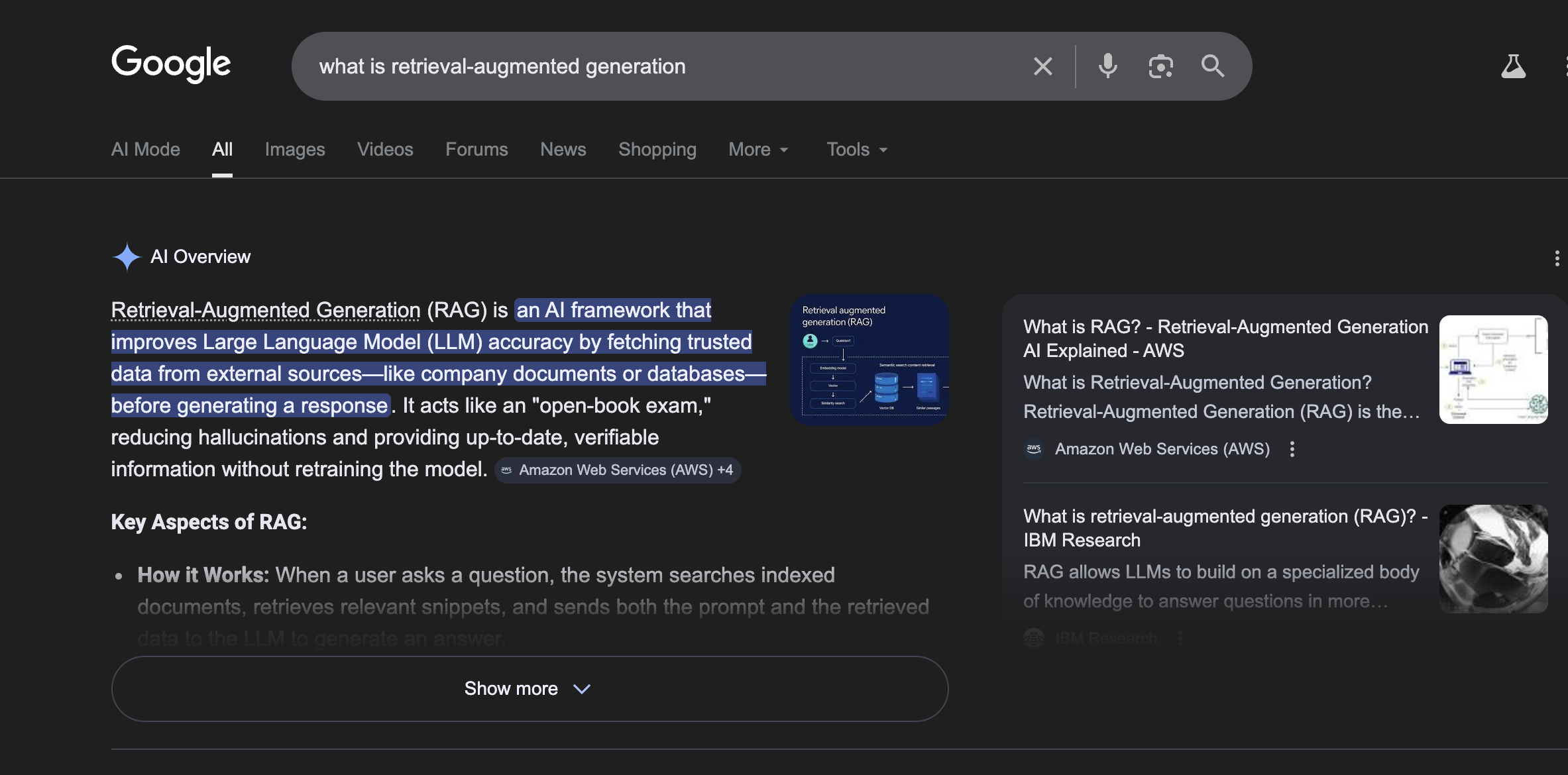
If you've noticed that Google search results look different lately, you're not imagining it. The AI-generated summaries sitting above the normal search results, the direct answers that require no click, the way ChatGPT and Bing now respond to questions that used to send people to websites — all of that is powered by a technology called Retrieval-Augmented Generation, or RAG.
You don't need to be a technologist to understand it. But you do need to understand it, because it is actively reshaping how your potential customers find information — and whether your business shows up when they do.
Let me break it down in plain terms, and then show you exactly how we account for it in our SEO strategy.
What Is Retrieval-Augmented Generation?
Start with the basics. AI tools like ChatGPT, Google's AI Overviews, and Perplexity are all built on something called a large language model (LLM). These models are trained on enormous amounts of text — articles, books, websites, research papers — and they use that training to generate responses to questions.
Here's the problem: that training has a cutoff. Once an LLM is trained, it only knows what it knew at that moment. Ask it something that changed after its training ended, and it may give you a confident, well-written, completely wrong answer. LLMs know how words relate statistically, but not what they mean — and sometimes they regurgitate random facts from their training data as if they were current truth.
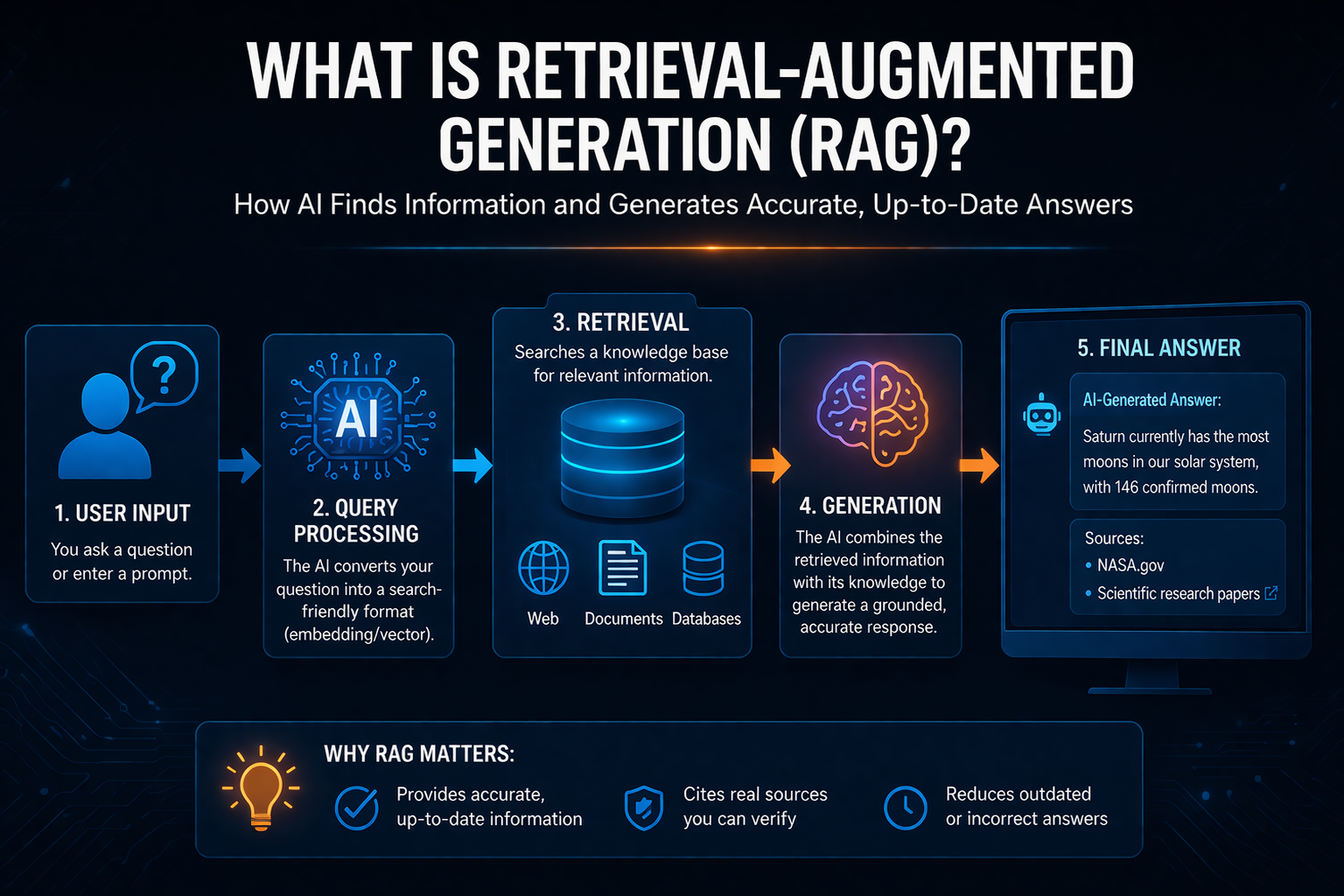
IBM Research Scientist Marina Danilevsky puts it well with a simple example. Imagine asking an AI, "Which planet in our solar system has the most moons?" A standard AI might confidently answer Jupiter — because that was once true. The correct answer today is Saturn, with 146 confirmed moons. The AI isn't being deceptive. It's just working from outdated information with no way to know it's outdated.
This reveals two core problems that plague standard AI models:
Problem one: No source. The AI generates an answer with nothing to cite. You can't verify it. You just have to trust it, which you shouldn't.
Problem two: Out-of-date information. The model's knowledge is frozen in time. The world keeps moving. The AI doesn't.
Retrieval-Augmented Generation was built to solve exactly these two problems.
RAG is a technique for enhancing the accuracy and reliability of generative AI models with information fetched from specific, relevant data sources. Instead of relying only on what the AI memorized during training, a RAG-powered system looks things up before it answers — the same way a good researcher would consult a source before making a claim.
It's the difference between an open-book and a closed-book exam. RAG opens the book.
How Does Retrieval-Augmented Generation Work?
The process is more straightforward than the name suggests. Here's what happens behind the scenes when you ask an AI a question that uses RAG:
Step 1: Your question goes in. You type a question into Google, into a chatbot, into an AI assistant. That question is your prompt.
Step 2: The AI converts your question into a format it can search with. The AI model sends the query to another model that converts it into a numeric format so machines can read it — sometimes called an embedding or a vector. Think of this as translating your words into a language that a search engine can use to match meaning, not just keywords.
Step 3: Relevant content is retrieved from a knowledge base. The information retrieval model queries the knowledge base for relevant data, and relevant information is returned to the integration layer. That knowledge base could be the open internet, a proprietary database, a library of documents — whatever the system has been pointed at.
Step 4: The retrieved content gets combined with your original question. The AI now has two things: what you asked, and what it found. It builds a new, enriched prompt from both.
Step 5: The AI generates a grounded answer. In the generative phase, the LLM draws from the augmented prompt and its internal representation of its training data to synthesize an engaging answer tailored to the user in that instant — and can pass that answer along with links to its sources.
The result is an answer that is more accurate, more current, and — critically — backed by real sources that can be verified.
This is the engine powering Google's AI Overviews, Bing's AI chat, Perplexity, and many of the AI tools your customers are already using to research products, services, and solutions in your industry.
What This Means for Your Website — And Why Most SEO Agencies Are Missing It
Here's where it gets directly relevant to your business.
Google's AI Overviews utilize retrieval-augmented generation to provide customized responses for a more conversational and semantic search experience. That means when your potential customer searches for something you offer, they may receive an AI-generated answer before they ever see a single website link. That answer was pulled from somewhere. The question is whether it was pulled from your site or your competitor's.
Today's consumers might ask ChatGPT, Bing Chat, or Google's AI-powered results for answers instead of scrolling through traditional search engine result pages. Winning in that environment is not about stuffing keywords into a page title. It requires something more strategic.
Most SEO agencies are still playing the old game — chasing rankings with keyword volume tools, replicating what competitors are already doing, and building content that looks busy but doesn't actually establish authority. By the time they catch up to what's working, the landscape has already shifted.
How We Build for RAG Visibility — Not Just Rankings
At Gear Bunker Media, we approach SEO the way an intelligence analyst approaches a target. We're not looking at what your competitors are doing well. We're looking for what they aren't doing — the gaps, the unprotected flanks, the questions nobody in your space has answered with any real depth or structural integrity.
We call this the Target Package approach. It runs through three phases:
Exploit — We conduct a multi-source extraction across your competitive landscape. That includes traditional search data, topical authority mapping, and a direct analysis of AI visibility: what large language models are currently surfacing in your space, what questions they're pulling answers from, and which of your competitors' content is thin enough to displace.
Develop — Raw data means nothing without synthesis. We sit with what we find and ask: What's missing? What questions are your customers clearly asking that nobody has answered well? Where is there a gap between two well-covered topics that nobody has bothered to fill? Those gaps are your opportunity — and in a RAG-driven search environment, filling them well means becoming the source AI systems cite.
Disseminate — The intelligence becomes your content and visibility strategy: built to be retrieved, structured to be cited, and designed to establish your brand as the authoritative answer in your space.
Retrieval-augmented generation gives models sources they can cite, like footnotes in a research paper, so users can check any claims — and that builds trust. The goal of our content strategy is to make your website that footnote. The source the AI reaches for when your customer asks the question that leads them to you.
What's working now is understanding how language models retrieve and cite information, then positioning your content to be the authoritative source they pull from. That's not a trend to prepare for later. It's the current reality — and the businesses establishing that position right now are building a compounding advantage that will be very difficult to displace.
Ready to Be the Source?
RAG has changed the rules. The agencies that haven't noticed are still optimizing for a search environment that no longer exists. We build for the one that does.
If you want to understand where your competitors are exposed — and what it would take to own the ground they've left unguarded — let's talk.
Sources
Danilevsky, Marina. "Retrieval-Augmented Generation (RAG)." IBM Research. https://research.ibm.com/blog/retrieval-augmented-generation-RAG
"What Is Retrieval-Augmented Generation?" NVIDIA Blog. https://blogs.nvidia.com/blog/what-is-retrieval-augmented-generation/
"Retrieval-Augmented Generation (RAG)." Google Cloud. https://cloud.google.com/use-cases/retrieval-augmented-generation
"What Is Retrieval-Augmented Generation (RAG)?" IBM Think. https://www.ibm.com/think/topics/retrieval-augmented-generation
"What Is RAG? Retrieval-Augmented Generation AI Explained." Amazon Web Services. https://aws.amazon.com/what-is/retrieval-augmented-generation/
"How Retrieval-Augmented Generation Is Redefining SEO." iPullRank. https://ipullrank.com/how-retrieval-augmented-generation-is-redefining-seo
"Retrieval-Augmented Generation (RAG) and SEO." BrainZ Digital. https://www.brainz.digital/blog/rag-seo/
Witner, Scott. "Intelligence-Driven SEO: Target Package Strategy." Gear Bunker Media. https://www.gearbunkermedia.com/blog/intelligence-driven-seo-target-package-strategy
