The Beekeeper Program: Does It Really Exist?
Fiction, Framework, and the Shadow World of U.S. Covert Operations
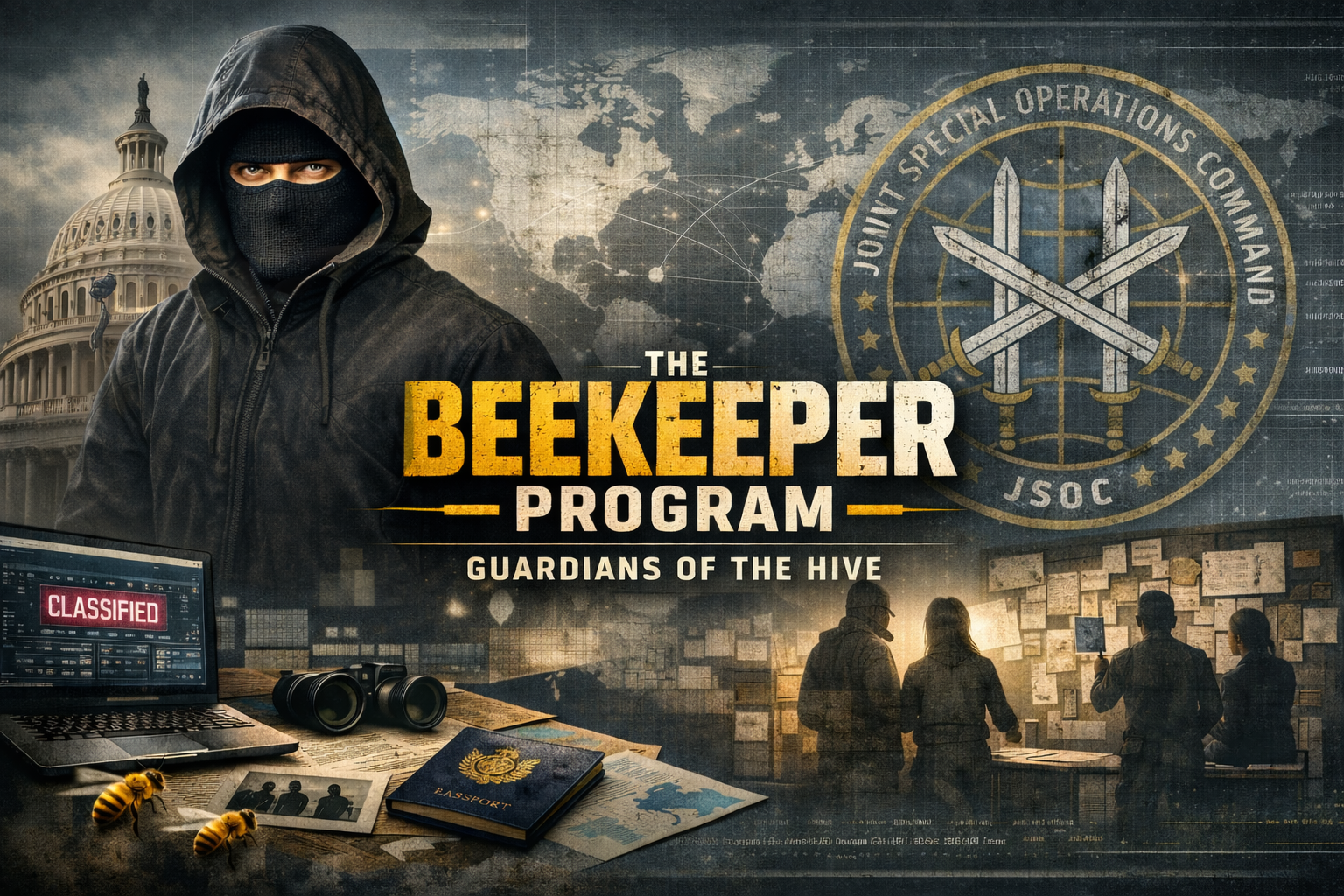
When the 2024 action film The Beekeeper hit theaters, audiences were captivated by its central premise: a shadowy, extrajudicial program operating outside all normal military and intelligence channels, activated to neutralize threats the government could not — or would not — address through conventional means. Jason Statham's portrayal of Adam Clay, a former operative of the fictional "Beekeeper" program, struck a chord not just because of its visceral action sequences, but because the underlying concept felt unnervingly plausible.
The Beekeeper program, as depicted, is not real. But the world it inhabits — clandestine special access programs operating in legal gray zones under Title 50 authority — is very much a documented reality of U.S. national security architecture.
This article examines the legal, historical, and operational frameworks that make the Beekeeper concept not merely entertaining fiction, but a surprisingly faithful — if dramatized — reflection of how the United States has structured some of its most sensitive intelligence and direct action programs.
The Legal Architecture: Title 50 and Covert Action
The film's reference to the Beekeeper program operating "under Title 50" is not merely scriptwriting flavor — it is a direct invocation of the actual legal authority that governs U.S. covert operations. Title 50 of the U.S. Code provides the primary statutory framework for the intelligence community, including the Central Intelligence Agency, and defines the parameters of covert action. Under 50 U.S.C. § 3093, covert action is defined as "an activity or activities of the United States Government to influence political, economic, or military conditions abroad, where it is intended that the role of the United States Government will not be apparent or acknowledged publicly."
Critically, a covert action under Title 50 requires a Presidential Finding — a formal determination by the President that the activity is necessary to support identifiable foreign policy objectives and is important to national security. This requirement, codified in the Intelligence Authorization Act of 1991 and refined through subsequent legislation, creates the legal predicate for activities that exist outside the traditional military operational chain of command governed by Title 10.
The tension between Title 10 (military authority) and Title 50 (intelligence authority) is not academic. Legal scholars and practitioners have long noted that the distinction creates, by design, a separate lane for operations where the government's hand cannot be shown. As one Congressional Research Service report noted, the two authorities are better viewed as "mutually supporting" rather than "mutually exclusive" — a characterization that, in practice, has enabled hybrid programs that blend military capability with intelligence-community authority and legal cover.
Special Access Programs (SAPs) — the classified designation for programs compartmented above the Top Secret level — represent the most restrictive tier of this framework. A program operating as a SAP under Title 50 authority would, by definition, operate with minimal congressional oversight, its existence known to only a handful of officials with a specific "need to know." The Beekeeper program, as depicted, fits squarely within this construct.
Historical Precedent: Detachment-A and the Stay-Behind Model
Perhaps the most striking real-world analogue to the Beekeeper concept is a program that actually existed: Special Forces Detachment-A (Det-A), the classified U.S. Army Special Forces unit that operated undercover in Cold War Berlin from 1956 to 1984. Officially designated the 39th Special Forces Operational Detachment, Det-A's existence was so closely held that it was technically illegal under the Four-Power Agreement governing Berlin — a program operating outside not just domestic but also international legal norms.
Det-A's operational concept closely mirrors the fictional Beekeeper program in several critical respects. Approximately 90 Green Berets were forward-deployed under civilian cover, integrated into Berlin society, and maintained a 24-hour alert posture in anticipation of potential activation. They were not stationed on a military base or operating within a conventional command structure — they were, in the parlance of the intelligence community, "in the black." They used low-technology tradecraft, live drops, dead drops, invisible ink, and meticulous cover identities to operate in both West and East Berlin. They maintained pre-positioned weapons caches, safe houses, and demolition materials throughout the city.
The "stay-behind" mission was the core of their mandate: in the event of Soviet invasion, Det-A operators would allow enemy forces to overrun their positions, then activate and conduct sabotage, assassination of key military targets, and organization of local resistance movements — all without external support, extraction plans, or official acknowledgment. As one former member described the unit's standing orders, their wartime mission was essentially suicidal by design: "to cause havoc behind the enemy's lines" with the odds, as one account put it, being "suicidal."
Det-A was also tasked by the CIA in 1978 to locate and assess pre-positioned cache sites throughout Berlin — a detail that underscores the blended Title 10/Title 50 authority structure that characterized the program. Following its deactivation in 1984, Det-A's mission was transferred to the Physical Security Support Element (PSSE), operating under the cover of the 287th Military Police Company—an object lesson in how classified programs evolve, morph, and continue under new designations rather than simply disappear.
The operational parallels to the Beekeeper concept are significant: integration into civilian society before activation, clandestine tradecraft, operation outside conventional command authority, and compartmentalization deep enough to maintain plausible deniability even for the program's own government. If the Beekeeper's writers were looking for a template, Det-A fits the blueprint almost exactly.
The Contemporary Landscape: JSOC, Title 50 Operators, and the Gray Zone
The modern manifestation of these concepts is found in the relationship between the Joint Special Operations Command (JSOC) and the CIA. As has been documented extensively in the post-9/11 era, special operations forces — including operators from Delta Force and SEAL Team 6 — have been routinely transferred from military jurisdiction (Title 10) to CIA jurisdiction (Title 50) for specific operations. This legal mechanism, sometimes referred to as being "sheep-dipped," allows the application of elite military capability under intelligence-community authority, with the attendant benefits of enhanced operational security and legal cover.
The 2011 operation that killed Osama bin Laden is perhaps the most publicly acknowledged example of this framework. The SEAL Team 6 operators who entered Pakistani airspace were, at the time, operating under CIA jurisdiction — a Presidential Finding having been issued that brought the operation under Title 50 covert action authority. The "role of the United States Government" was expressly intended not to be publicly acknowledged at the time of execution.
The Intelligence Support Activity (ISA) — sometimes referred to by its various cover names — represents another data point in this continuum. Established in the aftermath of the failed 1980 Iran hostage rescue mission, ISA conducts clandestine human intelligence and signals intelligence collection in direct support of JSOC operations. Its operators integrate into target environments using cover identities and backstopped legends, gathering intelligence that enables direct action by other special mission units. Its very existence remained classified for years, and its operational details remain largely out of the public domain.
Congressional oversight of these activities has been a recurring source of friction. Lawmakers have repeatedly expressed concern that JSOC has not been transparent about categorizing Advance Force Operations (AFO) and Operational Preparation of the Battlefield (OPB) missions — activities that legally should require Congressional notification under Title 50 but have sometimes been characterized as routine Title 10 military activity to avoid that requirement. This oversight gap is precisely the kind of structural ambiguity that, in fiction, becomes the Beekeeper program.
The Operational Tradecraft: Low-Tech in a High-Tech World
One of the more analytically interesting aspects of the Beekeeper concept — both in the film and in the conceptual framework described above — is its emphasis on low-technology tradecraft and "digital signature reduction." In an era dominated by signals intelligence, drone surveillance, and pervasive digital monitoring, the deliberately analog operator presents a paradoxically difficult intelligence collection problem.
Det-A's operators in Cold War Berlin understood this implicitly. Their communications relied on physical dead drops, face-to-face meetings, and handwritten notes in invisible ink — not because digital alternatives were unavailable (they weren't in that era), but because any electronic transmission creates a signature that can be detected, geolocated, and exploited. The principle scales directly to the modern environment: a fully analog operator with a backstopped identity, no electronic devices, and a deep cover legend is, in many respects, harder to track than one relying on encrypted digital communications that, however secure, announce their existence by virtue of the encryption itself.
The concept of "going to ground" — reducing one's digital, physical, and signals footprint to near zero — is not a Hollywood invention. It is a documented tradecraft discipline taught within both the special operations and intelligence communities. The relocation under new "backstopped identities" following mission completion, as described in the Beekeeper concept, similarly reflects actual practice: establishing a new identity with authentic documentation, verifiable legends, and operational security measures designed to make the identity survivable under scrutiny.
The Domestic Question: A Bridge Too Far?
The film's most provocative departure from documented reality is its suggestion that a program like the Beekeeper could be activated against domestic threats. Under Title 50, covert action is explicitly defined as an activity to influence conditions "abroad" — the statute contains no provision for domestic application. Furthermore, Title 50 itself, and the Executive Orders governing intelligence activities, explicitly prohibit covert action "intended to influence United States political processes, public opinion, policies, or media."
That said, the history of U.S. intelligence and law enforcement is not without examples of domestic programs that operated in legal gray zones or outside their stated authority entirely — from the FBI's COINTELPRO to the NSA's post-9/11 domestic surveillance programs revealed by Edward Snowden. The systemic temptation to apply covert capabilities domestically, particularly when conventional legal mechanisms are perceived as insufficient, is a recurring theme in American national security history.
The fictional Beekeeper program's mandate to operate against threats "foreign or domestic" is precisely what makes it dramatically compelling — and constitutionally alarming. It represents the logical endpoint of a national security architecture that has, at various points in history, expanded its operational scope in ways that were not anticipated, authorized, or ultimately constrained by the legal frameworks that were supposed to govern it.
Conclusion: The Fiction Is in the Details, Not the Framework
The Beekeeper program does not exist — at least not under that name, and not with the specific mandate depicted in the film. But the architectural components from which it is assembled are real: the Title 50 legal framework enabling covert action with minimal oversight, the Special Access Program classification structure that shields programs from scrutiny, the historical precedent of stay-behind units like Det-A that integrated into civilian environments awaiting activation, the documented practice of transferring elite operators under intelligence-community authority, and the tradecraft disciplines of identity construction, signature reduction, and clandestine operations.
What separates the Beekeeper program from documented reality is a matter of explicit mandate and scope — not of operational capability or legal mechanism. The United States government has demonstrated, repeatedly and across administrations, the ability and willingness to construct programs of extraordinary secrecy and autonomy when it perceives the national security need. The question of whether something functionally similar to the Beekeeper exists today is not one that can be answered from open sources, which is, of course, precisely the point.
The most honest answer to the question "Does the Beekeeper program really exist?" is this: Not that we know of. But the world that would produce it — legally, institutionally, and operationally — is well-documented and very much intact.
DISCLAIMER
This article is an analytical exploration of publicly available historical and legal information, written in response to a creative work of fiction. It does not disclose, suggest, or speculate about any classified programs or activities. All sources cited are in the public domain.
